




This Novakid article reveals why some children learn English faster than others — from personalised attention, to confidence, consistency, and cognitive style.



If you’re wondering about the best age to learn a new language, you may be hoping for one clear answer. Should a child start at three, six or eight? In a Novakid survey, teachers most often chose ages 8–9 when asked when they see children pick up conversational English fastest. To understand what that answer means, it helps to look at what research says about children’s English exposure and progress.
Of the 345 teachers who answered, 105 (30.4%) chose ages 8–9. Ages 10–11 came next, with 76 responses (22%), followed by ages 6–7, with 64 (18.6%). Another 57 teachers (16.5%) said it varies too much to say. The remaining responses were ages 4–5 (14; 4.1%), 12–13 (21; 6.1%) and 14+ (8; 2.3%).
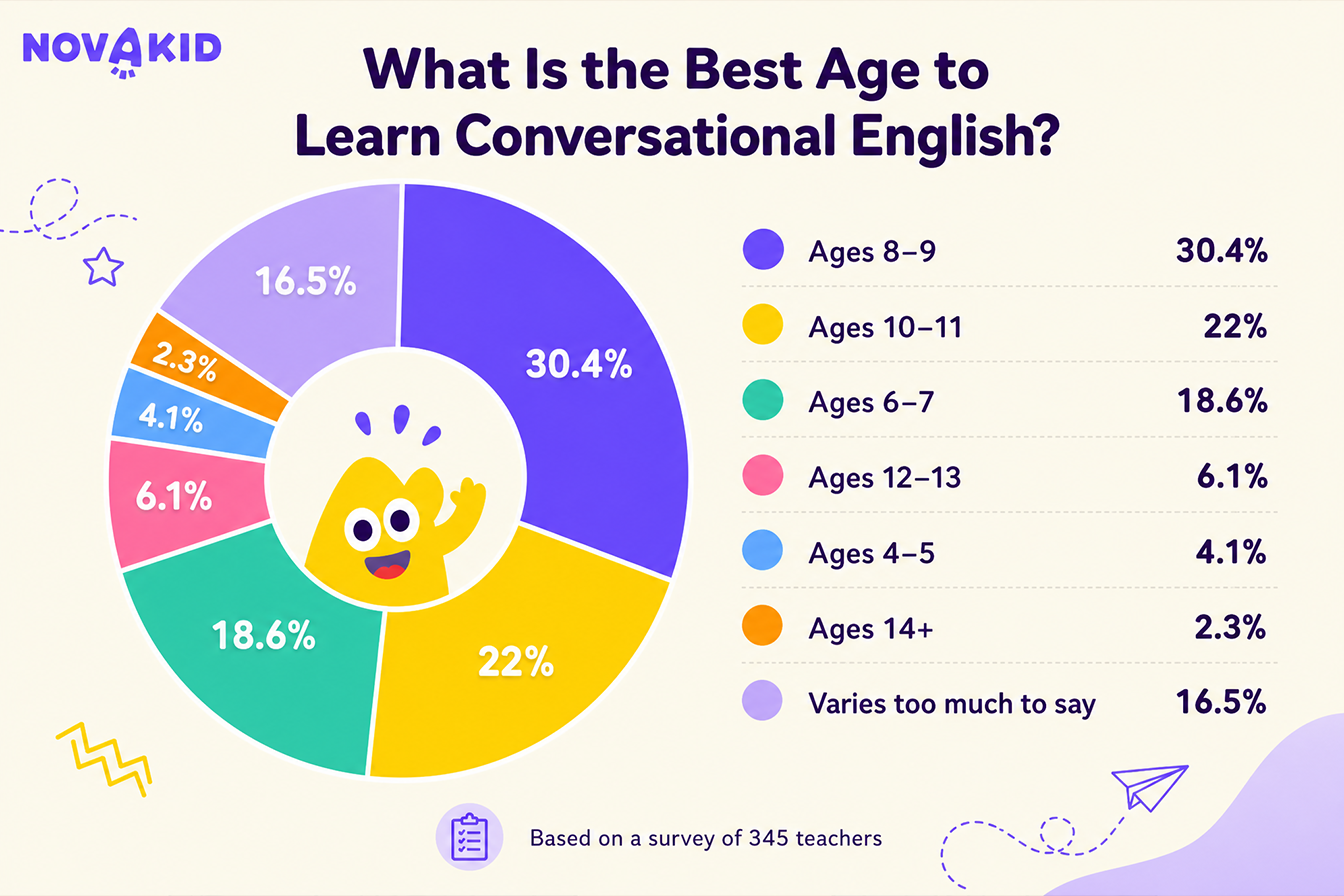
Together, ages 6–11 accounted for 71% of responses. Ages 8–9 were the most common choice, though no age group represented a majority. Could teachers be noticing a point when progress becomes more visible after children have spent time learning English? The survey can’t tell us, but research offers a few clues.
Across studies of language learners, exposure comes up as one part of the picture. The research covers different ages and skills, but several studies link learners’ English exposure—in lessons and beyond—to their performance.

One study close to the survey’s age range looked at children’s English exposure outside school. In Hong Kong, researchers studied children aged 8–12. Their parents or guardians described the English the children encountered beyond the classroom, and the children took tests in listening, reading, speaking and writing. Spoken exposure was more strongly associated with proficiency than written exposure. Together, the exposure measures accounted for about a quarter of the variation in test scores. That’s a relationship between exposure and results, not proof that exposure alone caused higher scores. Read the Hong Kong study.
Comparisons between starting ages raise another question: how much English instruction had each group received? A German study compared students who began English at ages 6–7 or 8–9. Researchers tested their listening and reading in Years 5, 7 and 9. The earlier starters scored higher in Years 5 and 9; the later starters scored higher in Year 7. By Year 5, though, the earlier starters had received 105 more English lessons. Because starting age and lesson time differed together, the study can’t show that age alone accounts for the score patterns. It also didn’t test speaking. Read the German study.
A study focused more directly on speaking, although it involved adult learners: 160 university students in Spain who had learned English as a foreign language. Carmen Muñoz analyzed their spoken retellings of a film, assessing fluency, vocabulary and sentence complexity. English input was more strongly associated with oral performance than starting age. The participants were adults, and the task was a film retelling rather than everyday conversation, so the results can’t tell us how children aged 8 or 9 develop conversational English. Read the study.

Development may be one part of the picture. A study of 111 English-speaking children aged 8–9 who were learning French found that their ability to analyze language was linked to their achievement. This suggests that noticing patterns in words and sentences can matter for some learners by this age. But the study didn’t compare different age groups or examine conversational English, so it can’t show that 8–9 is a particularly effective age or explain the survey result. Read the study.
Not necessarily. The survey records when teachers notice faster conversational progress, not when their students started learning English. Some may have been learning for years by then, with different amounts of exposure. Ages 8–9 were the most common answer about visible progress; they aren’t a recommended starting age. For another perspective on when to start, watch this video:
In another survey question, teachers were asked which home-support activities help their students. Daily English conversation was selected by 86.4% of teachers. Cartoons and videos, and reading together, were also among the activities teachers chose. These are teachers’ views on what helps, rather than measured effects—but they offer parents some practical ways to make English part of a child’s routine.
A story, a video or a short conversation can all give a child a reason to use English. For more guided speaking practice, explore Novakid’s English lessons for children.


There’s no single age when learning a language becomes difficult or impossible. Age can shape how someone learns, but progress also depends on their exposure to the language and opportunities to practise.
Not necessarily. General intelligence and language-learning aptitude overlap, but they aren’t the same. Language-learning aptitude can relate to progress, though its predictive value varies across skills. A high IQ alone doesn’t guarantee faster progress in conversation. Cambridge Core
There’s no universally hardest age to teach. What works depends on the child, their experience with English, what they’re learning and how it’s taught.
Make room for short, relaxed exchanges about things your child enjoys. Ask a simple follow-up question, give them time to answer, and focus on keeping the conversation going rather than correcting every mistake.
There isn’t one easiest age for every learner or every goal. Children’s progress varies, and the age they start doesn’t determine how quickly they’ll become comfortable speaking.
This Novakid article reveals why some children learn English faster than others — from personalised attention, to confidence, consistency, and cognitive style.
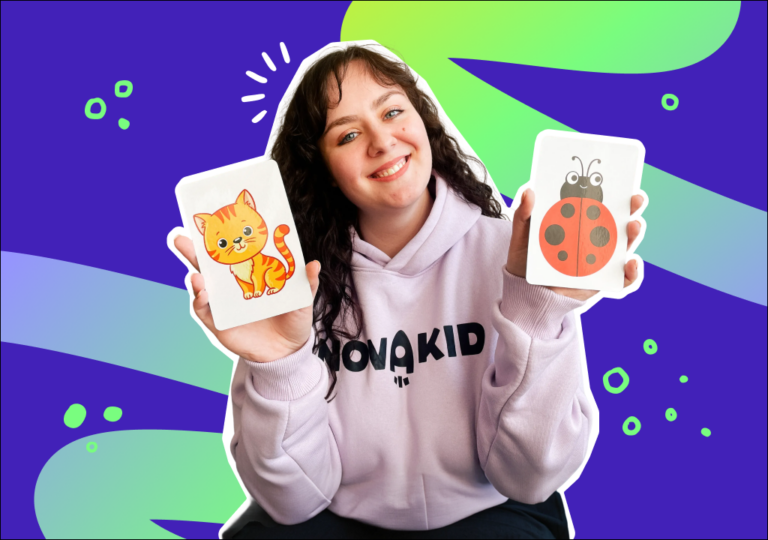
What happens when teachers, not algorithms, shape learning? Discover what educators and research reveal about AI English learning, and what it means for children.

Discover how attention spans and screen fatigue affect children’s learning, and which strategies help maintain focus in online English lessons.
A survey of over 130 English teachers reveals why English classes still matter for kids in the age of AI.
Find out what research and Novakid teachers say about the limits of learning a language by immersion, how language listening alone fails, and why structured teaching and practice turn exposure into fluency.

Discover how AI is transforming English learning. Explore the benefits of 24/7 tutoring, the risks of cognitive atrophy, and the future of education.
We and our partners use cookies to improve your experience, personalize content and ads, and analyze traffic. By clicking 'Accept all', you agree to our use of cookies in accordance with the Cookie Policy.
You can personalize your choices by clicking on 'Cookie settings'.
We use four types of cookies on our website. You can learn more about cookies and how we use them here: Cookie Policy
Strictly necessary
Advertising
Analytics
Personalization