



Explore what research and teachers say about homework AI, the pros and cons of homework, and why kids need lighter tasks and smarter use of AI.


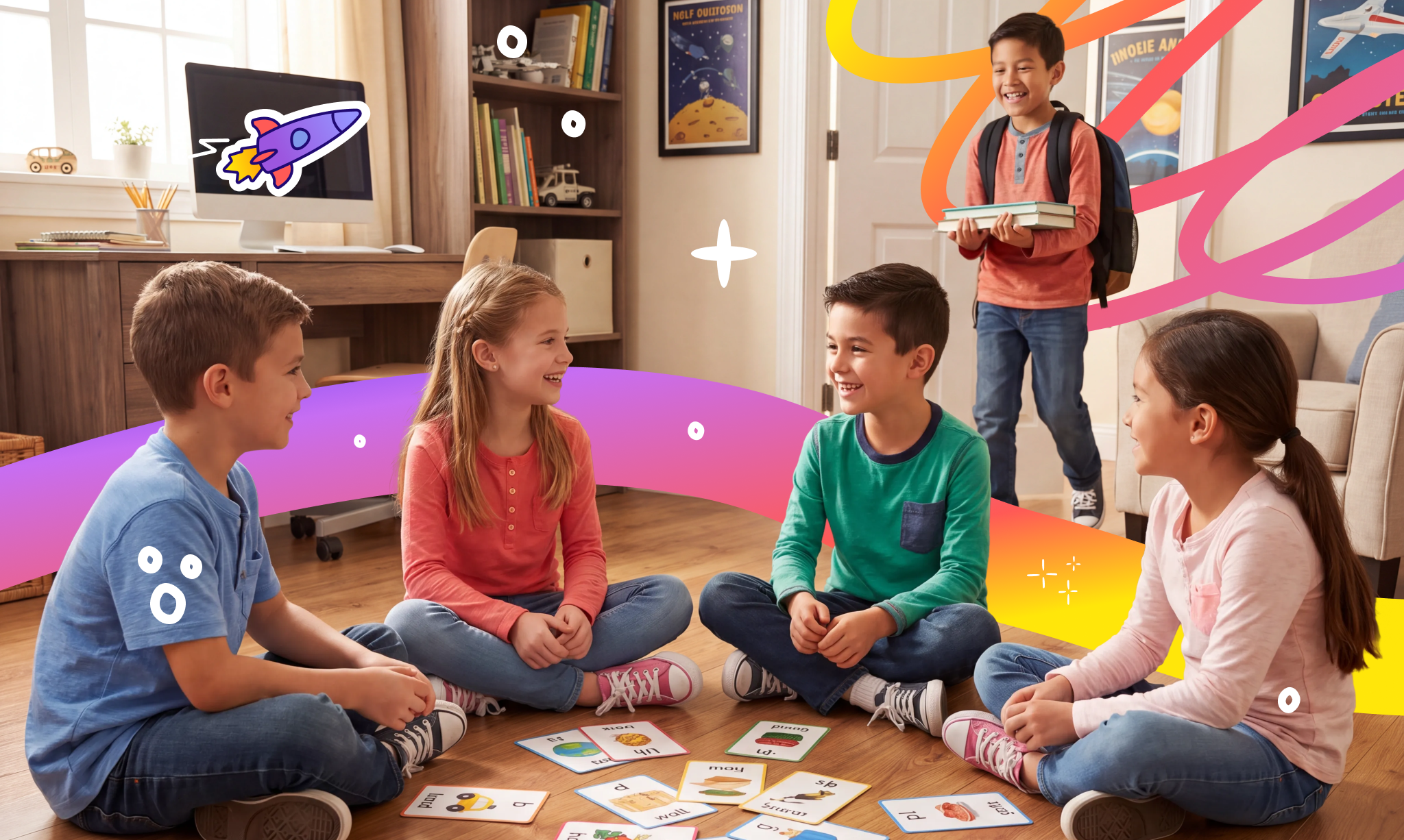
Most parents know this child. She gets top marks on her vocabulary test. She can fill in every blank on the worksheet. But when a visitor asks her a simple question in English, she looks at the floor, turns to you, and waits for you to answer.
That gap between knowing and saying is not really about English. It is about confidence: the willingness to open your mouth, risk a mistake, and be heard. Report cards rarely measure it, yet it shapes how children learn, make friends and cope with pressure. Language researchers have a name for it: communicative confidence, a child’s belief that they can get their message across, even with imperfect words.
To understand how that confidence is built, Novakid asked 347 online English teachers from around the world to share what they see working with their students week after week. Their answers, combined with international research on children’s social and emotional skills, point to a clear idea. Speaking a second language, in the right conditions, is one of the best everyday workouts for a child’s self-belief.
Confidence should not be taken for granted. The OECD’s Survey on Social and Emotional Skills 2023, the largest international study of these skills among 10- and 15-year-olds, links skills such as assertiveness, sociability and stress resistance to better grades, higher life satisfaction and less test and class anxiety.
The same research also carries a warning. In earlier rounds, 10-year-olds reported higher social and emotional skills than 15-year-olds in almost every area, with the drop steeper for girls. In several of the cities taking part, self-reported skills were lower in 2023 than before the pandemic. World Bank analysts suggest this may be linked to declining youth mental health and heavier use of smartphones and social media.
Speaking itself is under strain. In the UK, the charity Speech and Language UK estimates that at least 1.9 million children, about one in five, are behind in speaking and understanding words, the highest figure it has recorded. In response to this kind of concern, England’s Oracy Education Commission called in 2024 for speaking and listening to become the “fourth R” of education, alongside reading, writing and arithmetic.
Words and self-esteem are closely linked. The Oxford Language Report, published by Oxford University Press with contributions from researchers at the University of Oxford’s Department of Education, surveyed more than 1,300 UK teachers. Over 80% said a limited vocabulary affects pupils’ self-esteem. A follow-up report surveyed more than 3,500 teachers, and 80% of them said vocabulary difficulties lower pupils’ self-esteem and raise the risk of poor behaviour. A child who lacks the words, in any language, is a child who learns to stay quiet. Giving children the words, and the chance to use them, is one of the most practical ways to improve their self-worth and self-esteem.
The message for parents is simple. A child’s ability to speak up is a skill in its own right, and it can be trained.
The best-known advantages of studying a foreign language are usually described as cognitive or academic achievements, however some of the most valuable advantages are emotional. Speaking a new language is, by definition, speaking before you feel ready. Every sentence is a small risk: the wrong word, a strange sound, a pause. When that risk ends well, a child collects proof that trying is safe. Psychologists call these “mastery experiences”, and they are one of the strongest sources of self-belief.
The opposite also happens. Language researchers have described “foreign language anxiety” since the 1980s, and Stephen Krashen’s well-known “affective filter” idea holds that a nervous learner takes in less of what they hear. Fear does not only feel bad, it blocks learning.
There is a social upside too. A University of Chicago study published in Psychological Science tested 72 children aged 4 to 6 on a game that required seeing things from another person’s point of view. Children who were simply exposed to another language chose correctly 76% of the time, almost the same as bilingual children (77%). The authors suggest that hearing several languages trains children to think about what others mean, a core skill of empathy and of healthy language and communication development.
In other words, learning to speak English is never only about English. Done well, it is practice in being brave, being understood and understanding others.
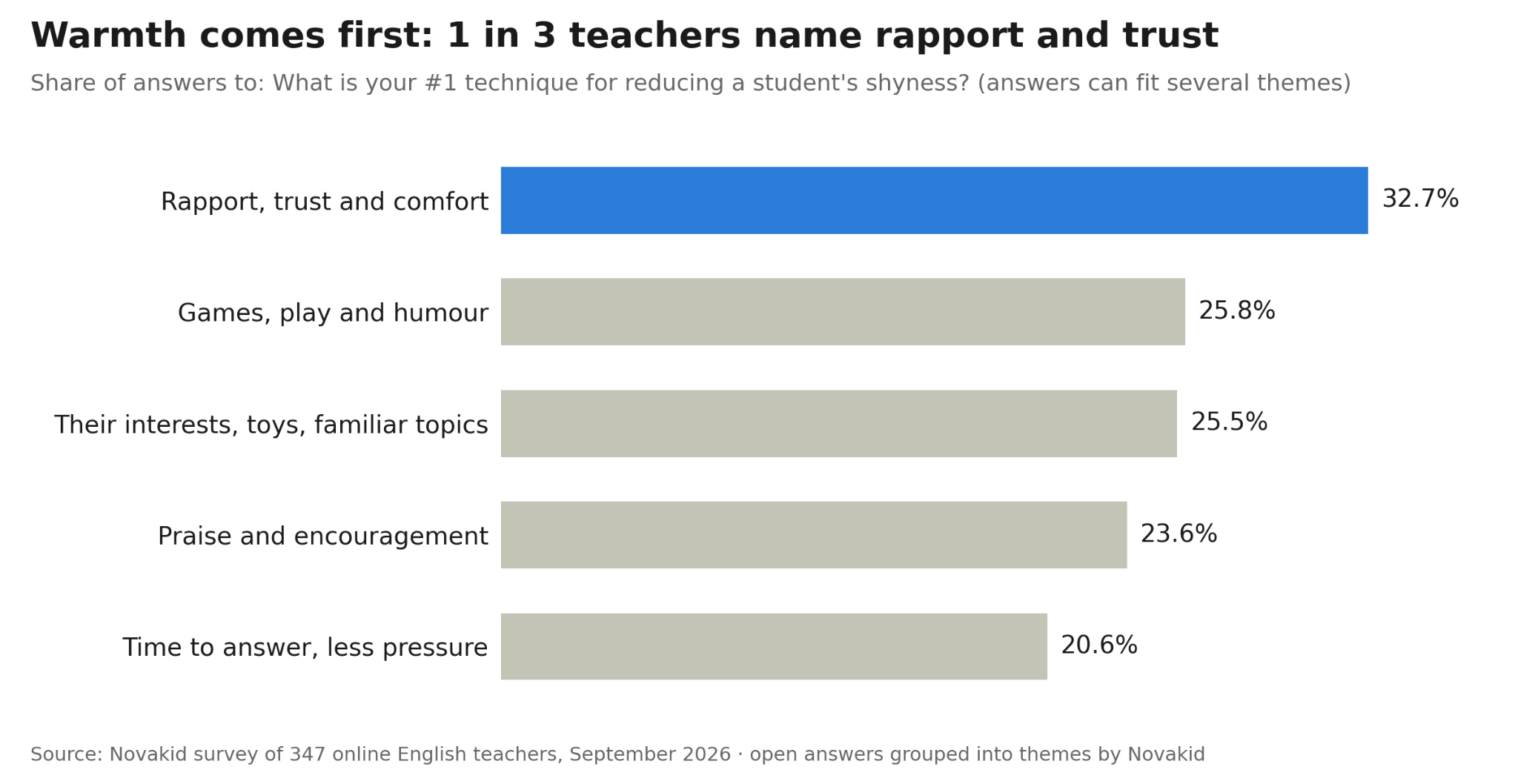
Novakid asked its teachers, who work with children in live online English lessons every week, for their number one technique for helping shy or anxious children feel more comfortable speaking English.Almost none of them mentioned grammar or drills. They spoke about feelings first.
Every theme in the top five is about how the child feels, not what the child knows. “When students are having fun, they forget they’re being judged and become more confident speaking,” one Novakid teacher explained.
Several teachers also described a technique called “echo and expand”: when a shy child gives a short or imperfect answer, the teacher repeats it back warmly and builds on it with a natural follow-up question. The child hears that they were understood, and gets a model of the correct sentence without being told they were wrong. Others start with movement, silly gestures or yes-or-no questions before asking for full sentences.
The lesson for parents is that confidence is built before speaking, not after. As the Novakid survey data shows, children need to feel confident before they can speak English confidently.
Many parents worry that children now talk to screens more than to people. The numbers explain why. According to the 2025 Common Sense Census, children aged 8 and under spend about 2.5 hours a day on screens, and 40% have their own tablet by age 2. Over the same period, daily reading among 5- to 8-year-olds has fallen from 64% to 52% since 2017.
Screens are not the enemy of language learning. Cartoons, songs and apps all give children useful exposure to English. The problem is that most screen time is passive. A child can watch hours of English videos without ever having to say a word out loud, which is exactly the part that builds confidence.
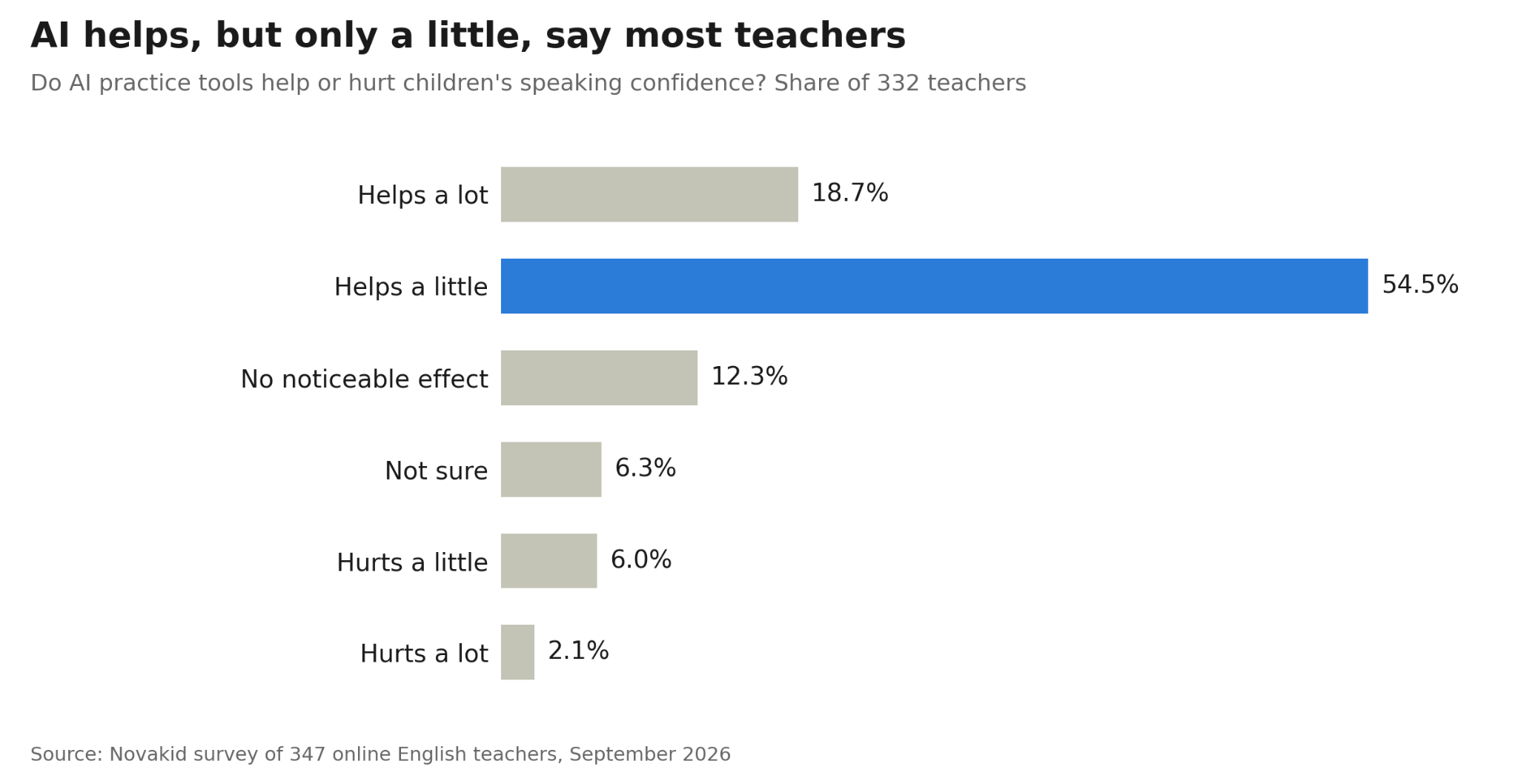
AI chatbots and voice assistants are changing this a little, because children can now talk back. In Novakid’s survey, 68.5% of teachers said at least some of their students use AI tools to practise English outside class. We asked whether these tools help or hurt speaking confidence.
The verdict is positive but modest: 73.2% of teachers said AI helps, yet most chose “helps a little”. In their written comments, several teachers said the same thing in different words: AI can generate practice sentences and offer a judgement-free space to try them out, but the personal conversation is missing, and that is what builds conversational confidence.
One Novakid teacher summed it up simply: “If the student is talking and laughing, they’re learning. If they’re staring at a screen silently, they’re probably not.” The practical takeaway for parents is to treat AI as a rehearsal room, not a replacement for real conversation.
We asked teachers about the single most common mistake parents make when helping with English at home. More than 300 wrote an answer, and two habits came up again and again: correcting every small error, and answering for the child before they have had time to think for themselves.
Both come from love. Nobody enjoys watching their child struggle for a word. But teachers describe the same effect from both: the child learns that speaking is risky, and that someone else will do it for them. “The most common mistake is overcorrecting,” said one Novakid teacher. “Parents focus too much on grammar and mistakes, instead of letting their child enjoy speaking English naturally. Confidence comes first, then accuracy.”
Another teacher warned that when parents hover too much, children become dependent and hesitant, and “start to think ‘What if I’m wrong?’”
Research on praise points the same way. In classic experiments by psychologists Claudia Mueller and Carol Dweck (1998), children praised for being clever tended to avoid harder tasks afterwards, while those praised for effort kept trying. A child who is told “well done for trying that sentence” has a reason to try the next one.
What teachers suggest instead is simple. Wait a few seconds longer than feels comfortable. If the sentence is wrong, repeat it back correctly in a natural way instead of saying “no”. For example: if your child says “Yesterday I go park”, you can answer “Oh, you went to the park yesterday? What did you do there?” The message received is “I understood you”, not “you got it wrong”.
One teacher’s advice for parents who do not speak English themselves stands out: you do not need to be a teacher, just a cheerleader. Ask your child to teach you the words they learned in class. “Turning the child into the teacher boosts their confidence immensely and takes the pressure off the parent.”
When we asked teachers which home activities really make a difference, one answer stood far above the rest: everyday conversation in English.
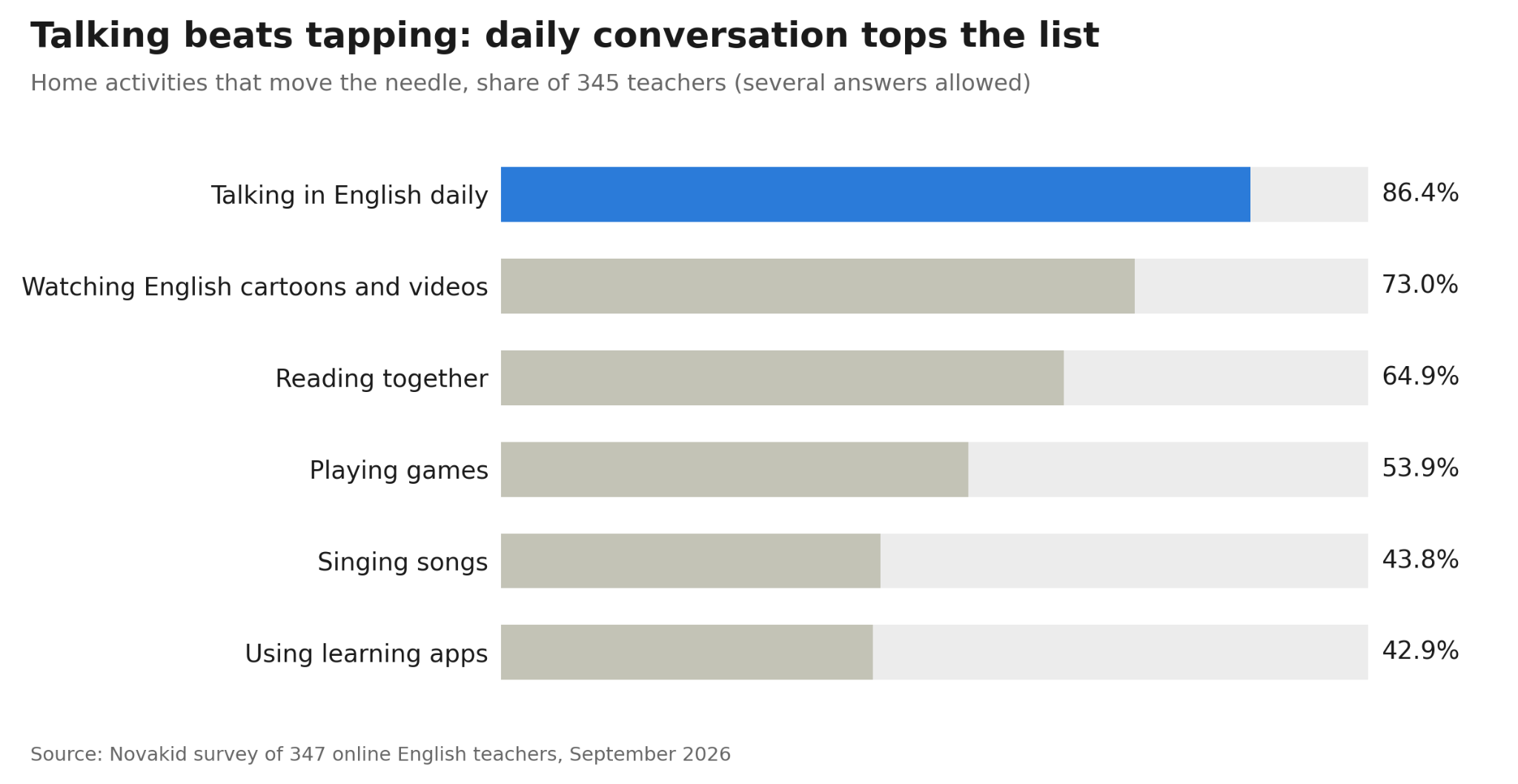
Talking in English daily was chosen by twice as many teachers as learning apps. Cartoons, reading and songs all help children hear the language, but conversation is the moment a child has to find a word and say it, which is where confidence grows.
The good news is that it does not take much time. The most common answer on extra practice needed for a noticeable improvement was 15 to 30 minutes a week (38.6% of teachers), and 71.4% chose between 15 and 60 minutes. Here are simple ways to use those minutes, taken from teachers’ answers:
Age matters too, but there is no deadline. Teachers most often see conversational English pick up fastest at 8 to 9 (30.4%), and early exposure lays the ground for that moment. Above all, parents need patience: real fluency takes time, and every child moves at their own pace. Whatever the age, the goal is the same: a child who would rather try than stay silent. That is a result no report card shows, and one that lasts far beyond the English lesson.
At Novakid, children aged 4 to 15 learn English through live online lessons and real conversation with a teacher, built around the idea that confidence comes first. If you want to see the difference for yourself, book your child’s free trial lesson and watch them take their first confident steps in English.


Children build confidence through small, repeated successes: trying something, being understood and being encouraged. Speaking a second language offers many of these moments. In Novakid’s survey of 347 teachers, rapport, play and praise for effort were the most common ways to help shy children open up.
Beyond grades and career prospects, learning another language gives children regular practice in speaking up, making mistakes safely and understanding others’ point of view. These are skills that support self-esteem and communication in any language.
It can, when children get regular chances to speak in a safe setting. Each successful attempt is a small proof that trying is worth it. In Novakid’s survey of 347 teachers, the most common technique for easing shyness was building rapport, trust and comfort (32.7% of answers).
Yes. Teachers in the survey hear versions of this question from parents. Understanding usually comes before speaking, and anxiety can hold speech back. Low-pressure conversation, patience and praise for effort help close the gap.
Less than many parents think. The most common answer among the teachers surveyed was 15 to 30 minutes of extra practice a week (38.6%). Short, regular and enjoyable beats long and stressful.
Not every one. Teachers report that constant correction makes children hesitant. Repeat the sentence back correctly in a natural way, and save direct correction for patterns that keep coming back.
They can help a little. 73.2% of teachers surveyed said AI tools help speaking confidence, but most described the effect as limited, and only 18.7% said they help a lot. Teachers see AI as extra practice, not a replacement for real conversation.
The most common answer was 8 to 9 (30.4% of teachers), the age at which they see conversational English pick up fastest. Earlier exposure still matters, because it builds the sounds, words and comfort children draw on later.
Explore what research and teachers say about homework AI, the pros and cons of homework, and why kids need lighter tasks and smarter use of AI.
Discover 10 techniques to reduce nervousness when kids speak English, based on insights from 347 Novakid English teachers and research on language anxiety.
Individual or group lessons? Online or offline classes? Study with a tutor or an app? Exploring the benefits of one-on-one lessons over other types of classes.
Is it possible for a child to master English in just three months? We dive into the scientific reality of language acquisition timelines vs. popular expectations.
Discover how attention spans and screen fatigue affect children’s learning, and which strategies help maintain focus in online English lessons.
This Novakid article reveals why some children learn English faster than others — from personalised attention, to confidence, consistency, and cognitive style.
We and our partners use cookies to improve your experience, personalize content and ads, and analyze traffic. By clicking 'Accept all', you agree to our use of cookies in accordance with the Cookie Policy.
You can personalize your choices by clicking on 'Cookie settings'.
We use four types of cookies on our website. You can learn more about cookies and how we use them here: Cookie Policy
Strictly necessary
Advertising
Analytics
Personalization