




A game is a natural way for a child to learn. Games also facilitate a child’s spontaneous use of language, coordination, memory, alertness, thinking, etc.



Screens have become part of everyday family life. Children watch cartoons, play games, attend online lessons, and use apps to practise school subjects. But with so much discussion about the effects of screen time on children, parents can be left wondering whether any screen use is actually good for them.
The answer is more complicated than a simple yes or no.
Think about the difference between a child mindlessly scrolling through short videos and a child taking part in a live English lesson with a teacher. Both activities involve a screen, but one gives the child an opportunity to communicate, respond to questions, and practise a skill, whilst the other doesn’t involve any active thinking.
The important question isn’t simply how much screen time a child gets. It’s what they are doing, how they are engaging with the content, and what they are missing out on while the screen is on.
The screen time definition is straightforward: it refers to the time spent using devices with screens, including televisions, smartphones, tablets, computers, and gaming consoles.
However, screen time can mean many different things. It might involve schoolwork, video calls with family, an online English lesson, educational games, streaming cartoons, or recreational social media use.
These activities shouldn’t automatically be treated as equivalent. A 2020 systematic review and meta-analysis published in JAMA Paediatrics, which examined 42 studies, found that greater screen use was associated with poorer language skills in children, while educational programming and watching alongside caregivers were assisted with strong language skills.
This is why looking at screen time purely as a number of hours can be misleading.
Lists of “10 reasons why screen time is good” and “10 reasons why screen time is bad” can make the issue seem black and white. In reality, both benefits and risks depend on the child’s age, the content they use, and the role screens play in their daily life.
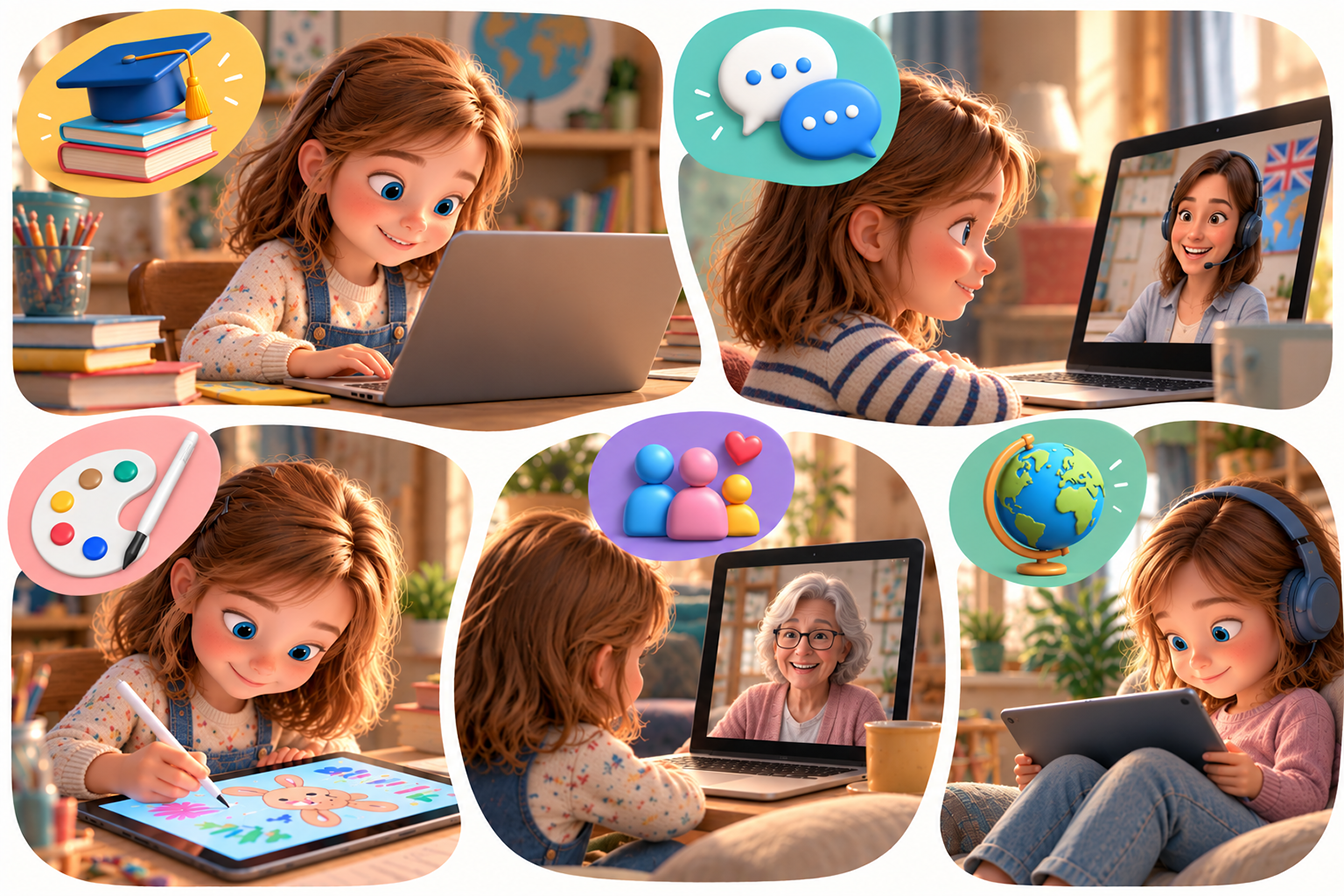
Well-designed educational apps can give children opportunities to practise maths, reading, spelling, and other skills. Quality matters though: an app should have a clear learning purpose rather than simply keeping a child entertained.
A live online English lesson can give children opportunities to listen, answer questions, speak and receive feedback. Educational cartoons and language games can provide additional exposure when they are age-appropriate and used thoughtfully.
Read this article to find out more about how cartoons, songs and games can help children to learn English.
Digital tools can help children draw, make music, design simple projects, or create their own stories. In these cases, children are doing something with technology rather than only consuming content.
Video calls allow children to maintain relationships with family members or friends who live far away. Interactive online lessons also create opportunities to communicate with teachers and other learners.
Online learning can connect children with teachers, educational resources, and learning opportunities that may not be available locally.
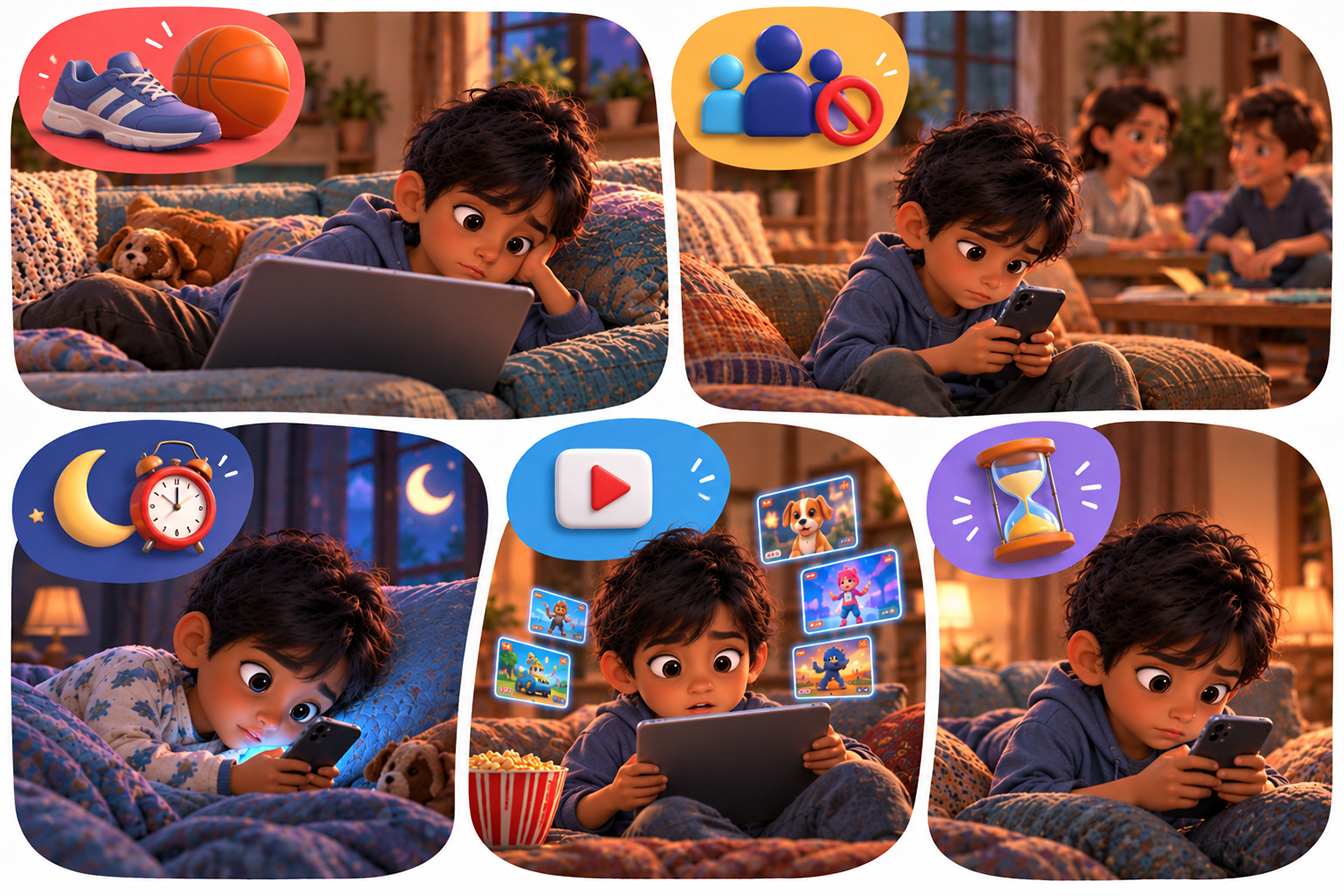

Children need regular movement, outdoor play, and opportunities to explore their surroundings in order to develop the necessary gross and fine motor skills needed for every day tasks.
Conversations with parents, siblings, teachers and friends provide important opportunities to practise communication and social skills.
Late-night screen time, notifications, and over stimulating visual content can make it harder for children to settle down and get enough rest.
Watching one video after another may leave little opportunity to ask questions, solve problems, or apply what has been learnt.
Autoplay, endless scrolling, and notifications are designed to keep users engaged. Children may need adult support to disengage, even when they know it is time to stop.
The key is to look at the whole picture. If screens regularly interfere with sleep, school, relationships, play, or everyday responsibilities, it’s time to reconsider the balance.
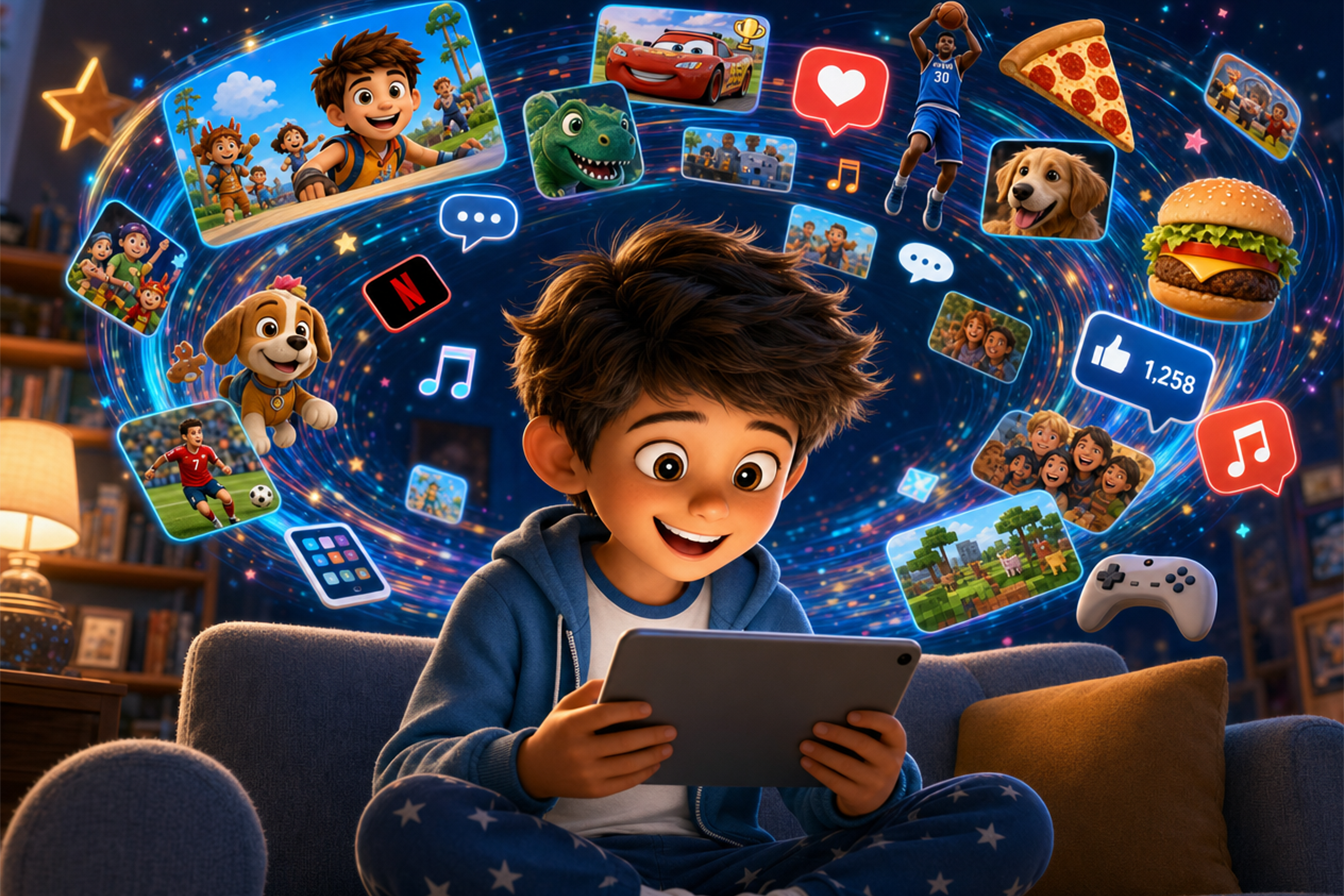
Have you ever noticed how quickly one online video leads to another? Many modern platforms use rapid editing, colourful visuals, frequent changes in scenes, and instant rewards to hold viewers attention.
Traditional classroom activities are often slower. Children may need to listen to a longer explanation, wait for their turn, work through a difficult question, or concentrate on a book without constant changes in stimulation.
It’s reasonable to ask whether children who spend a great deal of time with highly stimulating content might find these slower paced activities less immediately engaging. However, we shouldn’t assume that fast-paced screen content directly causes classroom concentration problems.

Parents often wonder how much screen time is healthy for their child. “The European Academy of Paediatrics recommends avoiding screen time before age two, except for video calls, and limiting it to no more than one hour a day for children aged 3-5” (Onorati et al., 2026). For older children, the focus is on choosing age-appropriate content and ensuring screens don’t interfere with sleep, physical activity, play or social interaction (Onorati et al., 2026).
These recommendations are a helpful starting point, but remember the quality matters as well as quantity. A purposeful online English lesson offers a different experience from hours of passive scrolling. The goal is to make screen time meaningful while leaving plenty of room for other activities children need to thrive.
If adults sometimes struggle to put their phones down, we cannot expect children to manage every digital temptation independently.
Children are still developing the ability to regulate impulses, manage frustration, and stop an enjoyable activity when necessary. Meanwhile, many apps and platforms are deliberately designed to hold users’ attention for as long as possible.
This is why parents need to take the lead in establishing clear, predictable boundaries.
Try these practical strategies:
Not every screen-based activity is designed to help children learn. A worthwhile educational experience should have a clear purpose and encourage children to think, communicate, practise, and apply new skills.
Novakid offers live online English lessons where children interact with teachers rather than simply watching a lesson passively. Through guided speaking practice, engaging activities, questions, and personalised feedback, children have opportunities to actively use English throughout the lesson.
Parents can help extend this learning beyond the classroom by encouraging their child to talk about what they learnt, practise the areas for improvement identified by their teacher in their personalised feedback, or explore the educational games in Novakid’s dedicated Kids’ Area. These activities offer additional opportunities to reinforce what they have learnt in class.
Screen time doesn’t have to be wasted time. With the right content, it can become an opportunity for your child to learn, practise and grow in confidence.
Ready to turn screen time into learning time? Book a FREE 25-minute trial lesson with Novakid and discover how our experienced teachers can help your child develop their English speaking skills in a fun, interactive online classroom.
Association 3-6-9-12. (2026). 3-6-9-12+ For sustainable, inclusive digital development, with and without AI. [Online]. 3-6-9-12.org. Available at: https://www.3-6-9-12.org/en [Accessed 22 October 2026].
Arbanas, J, Van Dyke, D, Arkenberg, C, Matheson, B, Widener, C. (25 March 2025). 2025 Digital Media Trends: Social platforms are becoming a dominant force in media and entertainment. [Online]. Deloitte Center for Technology, Media & Telecommunications. Available at: https://www.deloitte.com/us/en/insights/industry/technology/digital-media-trends-consumption-habits- [Accessed 22 October 2026].
Madigan, S., McArthur, B. A., Anhorn, C., Eirich, R., & Christakis, D. A. (2020). Associations Between Screen Use and Child Language Skills: A Systematic Review and Meta-analysis. JAMA pediatrics, 174(7), 665–675. https://doi.org/10.1001/jamapediatrics.2020.0327
Onorati, L., Papantoniou, G., Koletzko, B., Mazur, A., Karafyllidou, D.K., Baraldi, E. and Reali, L. (2026) ‘Screen Time Exposure and Children’s and Adolescents’ Health: A Position Paper from the European Academy of Paediatrics (EAP) and European Confederation of Primary Care Paediatricians (ECPCP)’, Acta Paediatrica, pp. 1–13. Available at: https://onlinelibrary.wiley.com/doi/10.1111/apa.70695


The 3-6-9-12 rule is a framework developed by French psychiatrist Serge Tisseron to help parents introduce screens gradually as children grow (Association 3-6-9-12, 2026). In its traditional form, it suggests no screens before age three, no personal gaming console before six, guided internet use rather than independent access before nine, and no social media before twelve.
Whether seven hours is unhealthy depends on what those hours include. Seven hours of schoolwork, online lessons, video calls and other purposeful activities is not equivalent to seven hours of recreational scrolling or streaming.
However, seven hours of recreational screen time would be a significant amount for a child, particularly if it leaves little room for sleep, movement, relationships, and offline activities.
There is no single global figure because surveys measure different things. However, a US survey reported that Gen Z respondents spent an average of 6.9 hours a day consuming media and entertainment content. This included activities such as streaming, social media, gaming and listening to music, so it should not be interpreted as a universal measure of total screen time (Deloitte Center for Technology, Media & Telecommunications, 2025).
Screen habits and ADHD are not the same thing. ADHD is a neurodevelopmental condition that affects attention, activity levels and impulse control. Excessive screen use, particularly when it interferes with sleep, may contribute to difficulties with attention and behaviour, but screen time alone cannot determine whether a child has ADHD.
If your child consistently struggles with attention or impulsivity at home and at school, speak to a qualified healthcare professional rather than assuming screens are the cause.
Could reducing screen time help? It may. Setting clearer screen time boundaries, protecting sleep and making more room for physical activity and offline play can support your child’s overall wellbeing. However, if your child has ADHD, reducing screen time is not a substitute for a proper assessment and appropriate support.
A game is a natural way for a child to learn. Games also facilitate a child’s spontaneous use of language, coordination, memory, alertness, thinking, etc.
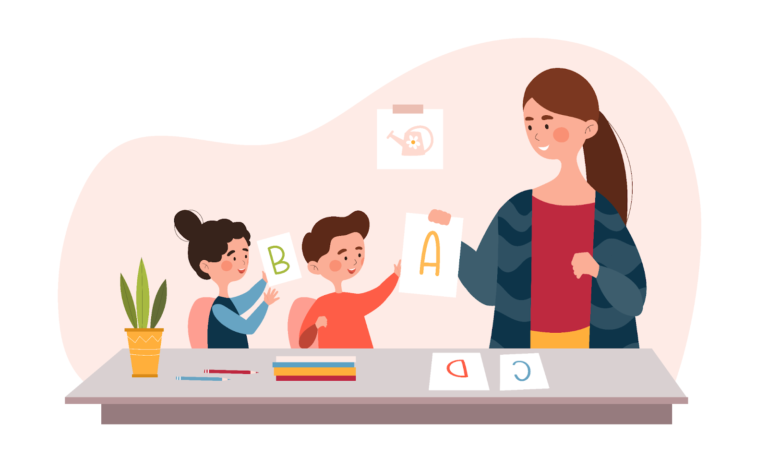
Learn how parents can support English language learning. Check out the tips on how to teach a child English in a fun and engaging way. Novakid got you covered.

Many parents that want their kids to study English still believe in the stereotype that the best method of learning English is the one they use in schools. We all know that this does not help children learn and speak English well...

Although the transition from private tutors to online education platforms was swift, parents had their time to decide how they felt about the opportunity to choose a teacher. The only question remains: how does one know the school is right for their kid, or they should change it?

Your kid is scared to speak English? Overcome the fear of public speaking! Find out ways to improve English speaking. Novakid helps kids learn English.
How playing helps learning outcomes and why gamification will continue to be important in the development of educational programmes.
We and our partners use cookies to improve your experience, personalize content and ads, and analyze traffic. By clicking 'Accept all', you agree to our use of cookies in accordance with the Cookie Policy.
You can personalize your choices by clicking on 'Cookie settings'.
We use four types of cookies on our website. You can learn more about cookies and how we use them here: Cookie Policy
Strictly necessary
Advertising
Analytics
Personalization