



Insights from English teachers on children’s speaking confidence, vocabulary retention, home practice, AI and the role parents play in language learning.



Can AI really help your child feel more confident speaking English? The short answer is yes, AI can offer new opportunities to practise, experiment with the language and overcome some of the fear of making mistakes.
But how useful are AI speaking tools really? We asked 347 Novakid English teachers to share their experience and tell us what AI can (and can’t) do to help children become more confident English speakers.
In this article, we’ll explore what teachers think about the role of AI and in children’s speaking confidence. We’ll also look at other ways parents can help their children feel more comfortable speaking English and the most common mistakes parents make that may undermine their child’s confidence when speaking English.
Can practising English with AI help children feel more confident when speaking? We asked Novakid teachers whether they think AI practice tools have a positive effect, a negative effect or no effect on children’s speaking confidence.
The results are mostly positive: 73.2% of teachers believe AI practice tools help children feel more confident speaking English. However, most teachers see this benefit as limited rather than significant. More specifically, 54.5% say AI helps a little, while 18.7% believe it helps a lot.
Not all teachers noticed a positive effect. A further 12.3% reported no noticeable effect, 6.3% were unsure, and 8.1% felt that AI tools could have a slightly or very negative impact on speaking confidence.
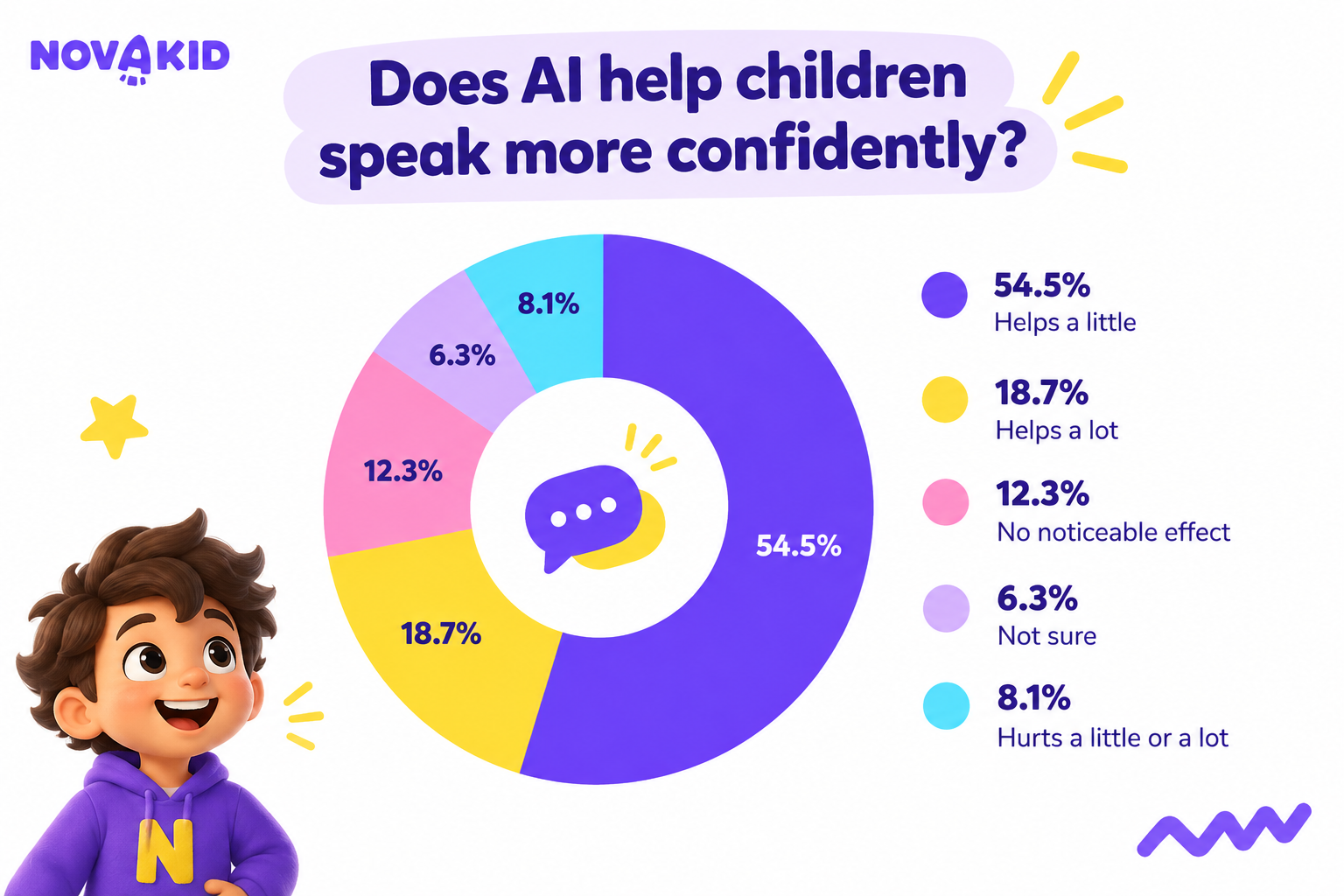
These findings suggest that teachers generally see AI as a useful addition to English practice, although they don’t consider it a solution on its own.
AI can give children additional opportunities to practise English, but speaking confidence involves much more than practising words and sentences. Children also need to feel comfortable making mistakes, expressing themselves and communicating with others.
This is where the role of a human teacher remains essential. Through personal interaction, encouragement and guidance, teachers can recognise children’s emotions, respond to their individual needs and create a supportive environment where they feel safe enough to speak.
Find out more about the dos and don’ts of AI speaking practice.

According to our survey, AI practice tools can be a valuable extra in a child’s English learning journey. Learning a language takes more than attending a lesson once or twice a week. Children need regular exposure to English, opportunities to use what they’ve learned, and activities that make them want to keep practising. AI-powered tools, together with games and interactive resources, can all help create a richer learning experience that extends beyond the classroom.
So, when choosing an English course for your child, it’s worth looking at the whole learning experience, not just what happens during lessons. But how can you tell whether a course offers the right combination?
Our guide on how to tell if an English course is right for your child covers five key questions to ask before making your choice.

Technology can offer extra practice, but it’s the interaction between teacher and student that helps turn language learning into a meaningful experience and gives children the confidence to express themselves.
Beyond teaching vocabulary and grammar, a good teacher encourages children to express themselves, helps them overcome their fear of making mistakes and gradually turns English from a school subject into a tool for real communication.
We asked Novakid teachers which strategies they find most useful for reducing shyness and anxiety when children speak English. Three approaches stood out: building trust, using games and humour, and talking about familiar topics that interest children.
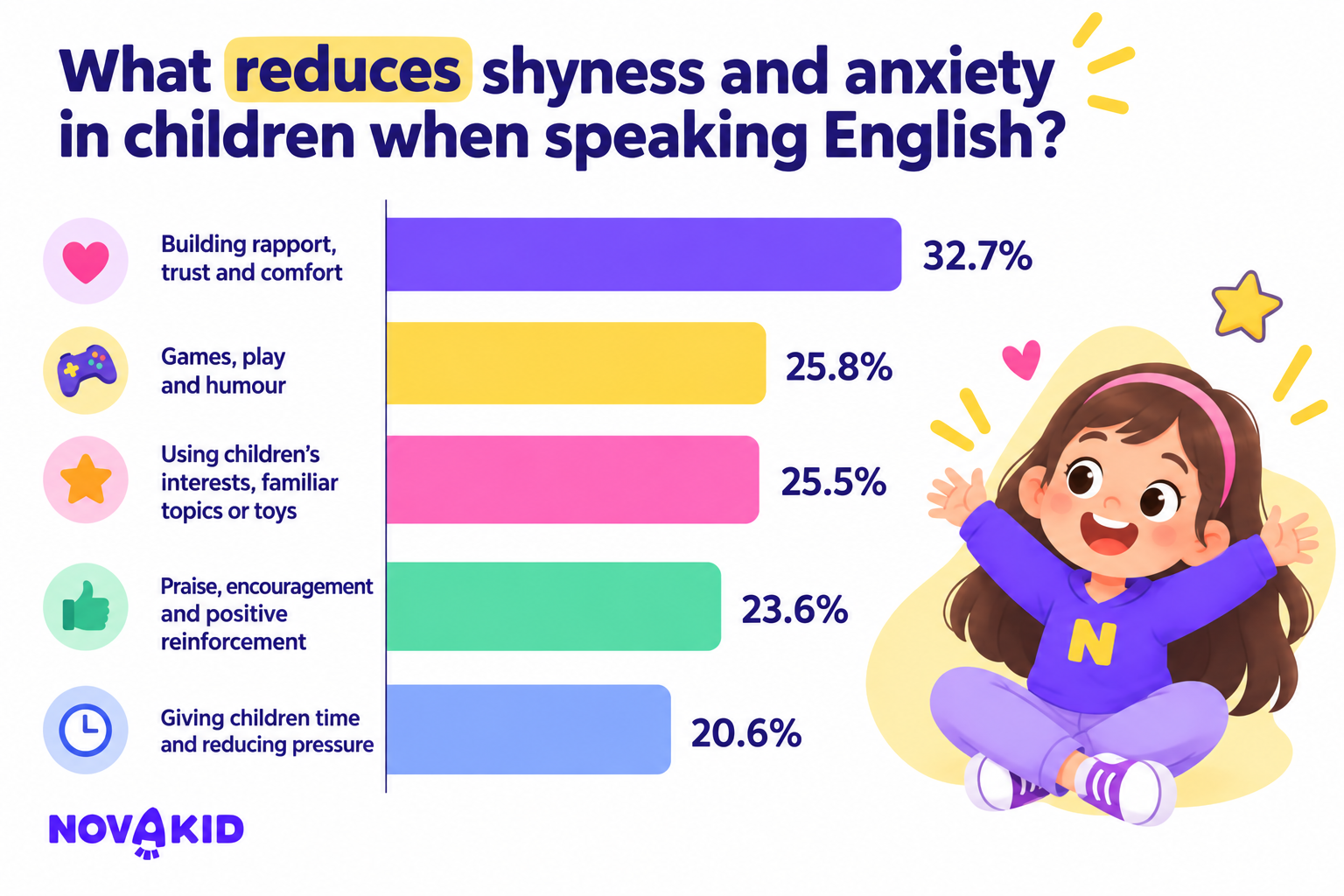
Some teachers also highlighted the importance of praise and encouragement (23.6%). A little patience and positive feedback can make a difference, especially for children who worry about getting things wrong.
A supportive teacher, an enjoyable activity and a topic they love can all help children take the first step towards actually speaking English.
Parents also play an important role in helping children feel more confident speaking English. But sometimes, trying too hard to help can have the opposite effect.
In our survey, Novakid teachers highlighted three common mistakes parents should avoid: answering for their child, correcting every small mistake and putting too much pressure on getting things right. These behaviours often come from good intentions, but they can make children more hesitant to speak.
So, what can parents do instead?
Making mistakes is a natural part of learning, and every attempt to communicate is a small step towards greater confidence. In the video below, you’ll find practical tips to help your child make faster progress in English and support their learning beyond the classroom.
At Novakid, we offer an integrated English learning experience that combines individual lessons with teachers specialised in teaching young learners, interactive games and activities, AI-powered tools and speaking groups that give children extra opportunities to practise English.
Want to discover how it works? Book a free trial lesson and explore the Novakid learning experience with your child.


Insights from English teachers on children’s speaking confidence, vocabulary retention, home practice, AI and the role parents play in language learning.

Explore an English learning formula through a survey of 300+ Novakid teachers and original studies on language and memory that might answer the question “Is English an easy language to learn?”.
Is there a best age to learn conversational English? See what Novakid teachers said and what research reveals about age, exposure and children’s progress.
A survey of over 130 English teachers reveals why English classes still matter for kids in the age of AI.
Explore what research and teachers say about homework AI, the pros and cons of homework, and why kids need lighter tasks and smarter use of AI.
Discover how attention spans and screen fatigue affect children’s learning, and which strategies help maintain focus in online English lessons.
We and our partners use cookies to improve your experience, personalize content and ads, and analyze traffic. By clicking 'Accept all', you agree to our use of cookies in accordance with the Cookie Policy.
You can personalize your choices by clicking on 'Cookie settings'.
We use four types of cookies on our website. You can learn more about cookies and how we use them here: Cookie Policy
Strictly necessary
Advertising
Analytics
Personalization